Photon Budget: A Technical Analysis of the GRAVITY Series for Reef Aquariums
Magazine
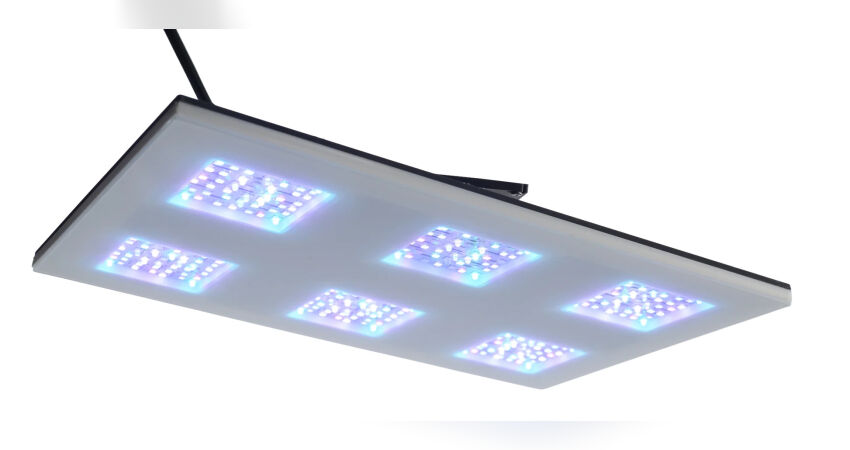
GRAVITY 32, sechs LED-Cluster im 3×2-Format, 90 W Systemleistung. Quelle: b-spx.com.
What really makes good light for corals? This technical analysis of the b.SPX GRAVITY LED series examines spectrum, PAR and PUR, optics, UV-A, and the modular design of the fixtures. The focus is on the principle of “Light Scaping”: not simply putting light into the aquarium, but directing it precisely to where corals actually need it. Author: Stefan Immke, inventor, developer and manufacturer of the GRAVITY series (b.SPX) September 2026 Subject: GRAVITY LED series, manufacturer b.SPX (b.OCEAN line)
Image credits: Product photography and official factory measurement data from b-spx.com; technical diagrams and concept graphics were created using AI-assisted tools based on these data.
1. Light Is Not an Accessory
At its core, a reef aquarium is a photobioreactor with aesthetic ambitions. The corals inside it perform photosynthesis through unicellular algae living within their tissue – Symbiodinium, commonly referred to as zooxanthellae. These algae contain chlorophyll a, chlorophyll c2 and the carotenoid peridinin, and each of these pigments has its own physically determined preference for specific wavelengths. Chlorophyll a absorbs primarily around 437 nm and again around 670–676 nm, chlorophyll c2 at approximately 453–460 nm, 585 nm and 630–634 nm, while peridinin broadly covers 470 to 550 nm – exactly the range in which chlorophyll alone would leave a gap1 2.
This is why reef aquarium lighting cannot be evaluated by PAR alone (Photosynthetically Active Radiation, 400–700 nm, measured in µmol photons · m⁻² · s⁻¹), but instead also considers PUR (Photosynthetically Usable Radiation): PUR weights the PAR spectrum according to the absorption curve of the zooxanthellae. An LED can therefore produce an impressive PAR reading while wasting a large proportion of it in a green spectral range that is of little photobiological use to the coral. Blue light between 400 and 500 nm is disproportionately valuable in this context because both chlorophyll a and peridinin operate within this range.
The second level is rarely discussed: corals are not passive. Tissue located deeper within the coral receives considerably less light than the surface – measurements in coral tissue show that at a depth of around 1,000 µm within the polyp, only about 10% of the incident radiation remains 3. Some coral species compensate for this using photoconverting fluorescent proteins that absorb blue light and convert it into orange-red light capable of penetrating deeper into the tissue 4. Put simply, the coral operates its own wavelength conversion system – a detail that helps explain why a clean blue spectrum in the aquarium is more important than arbitrary full-spectrum white light with a high lumen rating, or some other randomly assembled spectrum.
For the GRAVITY series from b.SPX (b.OCEAN line, Germany), this is precisely the starting point of the design philosophy: not “as much light as possible”, but a spectrum deliberately shifted toward the photobiologically usable window, measured using an EVERFINE PMS-2000 spectroradiometer and documented across all fixture sizes 5.
One aspect of this is often overlooked in reef keeping because it cannot be expressed as a single µmol figure: it is not enough for the correct wavelengths to come out of the fixture somewhere. They also need to arrive already mixed before they reach the coral – otherwise one branch of a colony may receive more blue light while another receives more white, simply because it is closer to one individual LED or another. How GRAVITY solves this problem through its design, while two widespread conventional approaches struggle with precisely this issue, is discussed later in the section “Premixed Light”.
2. Optics: Why Two Beam Angles Can Do More Than One
GRAVITY modules consist of individual LED clusters, with each cluster combining two different types of optics in equal proportions: 120° mid-power LEDs for broad, homogeneous area illumination and 60° high-power LEDs with primary optics (silicone lenses) for targeted depth penetration6.
The logic behind this is geometrically simple and therefore difficult to argue with: a single wide beam angle produces even coverage but rapidly loses intensity with depth. A single narrow beam retains intensity at depth but creates a pronounced hotspot directly beneath the fixture – with all the familiar consequences for light-sensitive tissue on the upper surfaces of SPS colonies. Combining both optics within the same cluster allows the cones to overlap: the 120° component fills the area, while the 60° component ensures that usable PUR light still reaches depths of 40 to 80 cm without turning the surface into one glaring central hotspot. This exact overlap pattern can be seen in the PAR simulation for the largest module in the series:
Offizielle PAR-Simulation der GRAVITY 43 (12 Cluster, 180 W). Die sich kreuzenden Linien zeigen, wie sich die festen 120°/60°-Doppeloptiken benachbarter Cluster überlappen; die Farbskala zeigt PAR in µmol · m⁻² · s⁻¹ bei 20 cm Montagehöhe. Quelle: b-spx.com.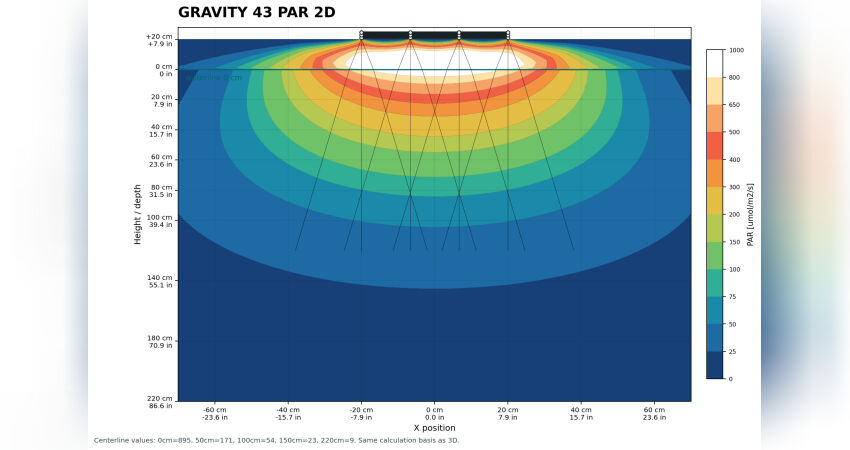
The second element of the optical concept is mechanical rather than photometric: every GRAVITY module is suspended from a single ball-head joint with ±20° tilt and 360° rotation 7. This is the difference between a fixture that simply shines downward from above and a system in which every module can be individually aimed at a specific part of the reef structure. The actual customization therefore does not happen within a single panel, but between multiple modules: anyone combining two or more GRAVITY units above an aquarium, depending on its size, can tilt and position each unit independently – a degree of flexibility that a single large, rigid fixture fundamentally cannot provide. In practice this means that peripheral areas of an aquarium which would otherwise remain shaded by the reef structure itself under a fixed overhead panel can be illuminated deliberately using an additional module angled from the side. After all, the sun does not illuminate a natural reef exclusively from directly overhead; over the course of the day it also arrives from the side – an effect that reduces self-shadowing in densely grown reef structures when technically reproduced instead of ignored. How this combination of several modules (“Light Scaping”) compares with a single large fixture, and which arrangements work well in practice, is covered in detail later on.
Kugelkopf-Gelenk, an dem ein GRAVITY-Modul aufgehängt wird, werkzeugfrei verstellbar, ±20° Neigung, 360° Rotation. Quelle: b-spx.com.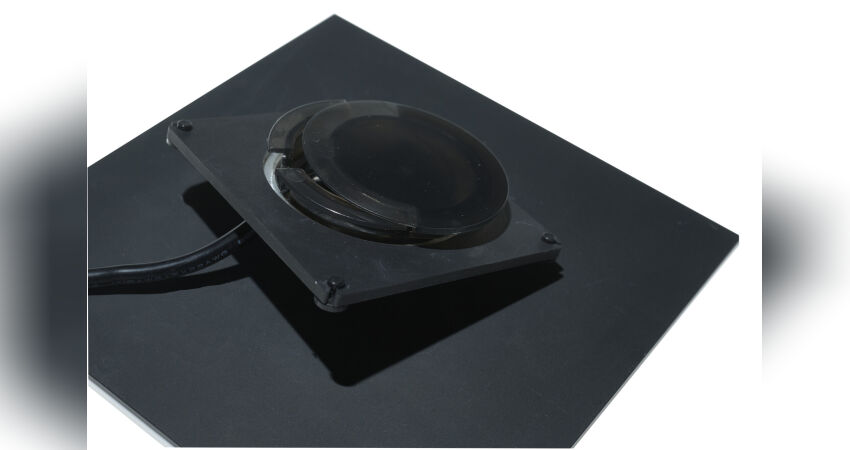


How do you like this article?
Info
Author

Bookmark
Comments
Topics
Similar articles
- Tropic Meeresaquaristik erweitert seine Eigenproduktpalette
- Orphek , die Diode macht den Unterschied
- Preiswertes LED Mondlicht im Selbstbau
- Ernährungsstrategien bei Korallen
- Der Newcomer - Econlux LED
- Die neue Orphek Atlantik V2
- PULZAR G3 marine & tropic
- Interzoo News: ECONLUX - super-flat 140 Watt LED
- FUNGIA Mushroom Corals
- ATI News: The new Straton Flex LEDs are here.
Comments To the top
Please register
In order to be able to write something yourself, you must register in advance.